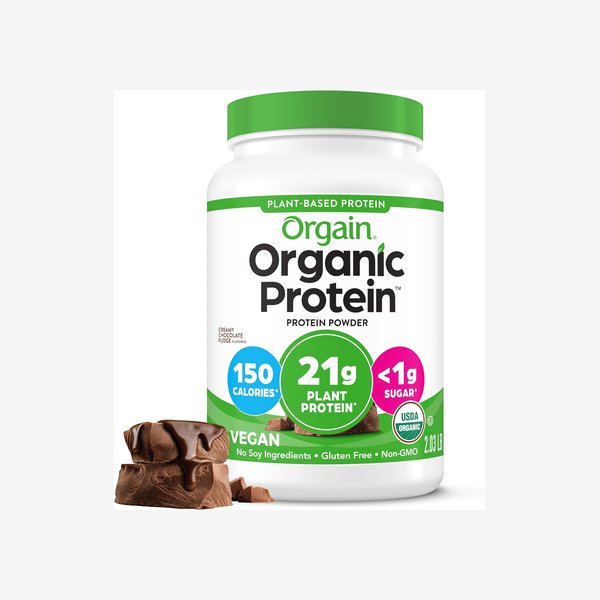
Garden of Life Organic Plant Protein
22g organic plant protein from pea and sprouted grains. USDA Organic, Non-GMO Project Verified, vegan, Informed Sport certified. ~130 calories per serving. No artificial sweeteners, flavors, or preservatives.
- USDA Organic and Non-GMO with clean ingredients
- Informed Sport certified for banned substance testing
- Complete amino acid profile from pea + sprouted grains
- Gentle on digestion with added probiotics and enzymes
- Taste and texture are polarizing among users
- Grittier mouthfeel compared to whey-based powders
Quick Verdict
Garden of Life Organic Plant Protein is the best plant-based protein powder we’ve found for men who refuse to compromise on ingredient quality. It delivers 22g of complete protein from organic pea and sprouted grains, carries both USDA Organic and Informed Sport certifications, and contains zero artificial anything. The trade-off is real: it doesn’t taste as good as whey, the texture is grittier, and it costs more per gram of protein. But for men who are vegan, lactose intolerant, or committed to organic nutrition, this is as good as plant protein gets. 4.2/5.
☑ Why You Can Trust This Review
- Our team personally tests every supplement we recommend — see our testing process
- All claims are backed by published research from peer-reviewed journals
- We are independently funded through affiliate commissions — brands cannot pay for rankings
- This content is written and reviewed by our editorial team
What Is Garden of Life Organic Plant Protein?
Garden of Life is a Florida-based supplement company founded in 2000 that has built its entire brand around organic, whole-food-based nutrition. They were among the first supplement companies to pursue and obtain USDA Organic certification across their product lines — a distinction that requires significantly more effort and cost than most brands are willing to invest. In 2017, Nestlé Health Science acquired Garden of Life, though the brand has largely maintained its formulation philosophy and certifications post-acquisition.
Their Organic Plant Protein powder uses a base of organic pea protein combined with a proprietary blend of 13 organic sprouted grains and seeds, including lentil, navy bean, garbanzo bean, flaxseed, amaranth, buckwheat, millet, cracked wall chlorella, quinoa, chia seed, sesame seed, sunflower seed, and pumpkin seed. This multi-source approach addresses the typical weakness of single-source plant proteins — incomplete amino acid profiles. Pea protein alone is low in methionine, while grains and seeds fill that gap.
Each serving provides 22g of protein from a 34g scoop, yielding a protein-to-weight ratio of about 65%. That’s lower than whey isolate but competitive for plant protein, where 55–65% is typical. The formula also includes 1.5 billion CFU of a proprietary probiotic blend (Lactobacillus) and a raw enzyme blend (lipase, protease, aspergillopepsin, beta-glucanase, cellulase, bromelain, phytase, lactase, papain, peptidase, pectinase, xylanase, hemicellulase) designed to improve protein digestion and reduce the bloating that some men experience with plant proteins.
Key Features & Specs
| Spec | Detail |
|---|---|
| Protein Per Serving | 22g |
| Serving Size | 34g (approx. 1 scoop) |
| Calories | 130 |
| Fat / Carbs / Sugar | 2g / 7g / 0g |
| Fiber | 2g |
| Protein Source | Organic pea protein, organic sprouted grain/seed blend (13 sources) |
| Servings Per Container | 28 (2 lb container) |
| Price Per Serving | ~$1.50 (2 lb container) |
| Flavors Available | Chocolate, Vanilla, Vanilla Chai, Unflavored |
| Certifications | USDA Organic, Non-GMO Project Verified, Informed Sport, NSF Certified, Vegan, Gluten-Free |
| Added Benefits | 1.5B CFU probiotics, raw enzyme blend (13 enzymes) |
Protein Quality: Can Plant Match Whey?
Let’s address the elephant in the room. Plant protein is not equivalent to whey protein gram for gram — and any brand that tells you otherwise is misleading you. Whey protein has a PDCAAS (Protein Digestibility Corrected Amino Acid Score) of 1.0, the highest possible score. Pea protein scores approximately 0.89, and blended plant proteins typically land between 0.85 and 0.95 depending on the blend.
The practical difference comes down to leucine. Leucine is the amino acid that triggers muscle protein synthesis, and whey delivers approximately 10–12% leucine content versus pea protein’s 7–8%. This means a 22g serving of Garden of Life provides roughly 1.5–1.8g of leucine, compared to the 2.5g+ you’d get from whey. The muscle-building threshold is generally considered 2–3g of leucine per meal.
The solution is straightforward: use a slightly larger serving. Research published in the British Journal of Nutrition (2022) found that 30–40g of plant protein produced equivalent muscle protein synthesis to 20–25g of whey in resistance-trained men. Garden of Life’s multi-source blend helps close the amino acid gap, but men focused on maximizing hypertrophy should consider using 1.5 scoops (33g protein, ~195 calories) to ensure adequate leucine.
The Organic Advantage
Garden of Life’s USDA Organic certification means the pea protein and all 13 sprouted ingredients are grown without synthetic pesticides, herbicides, or fertilizers. The Non-GMO Project Verification adds third-party confirmation that no genetically modified organisms are used. Whether organic protein is nutritionally superior to conventional protein is debatable — the protein molecules themselves are identical. The argument for organic is about what’s not present: pesticide residues, heavy metals from contaminated soil, and synthetic processing agents.
This matters more for plant protein than whey. Plant-based protein concentrates can accumulate heavy metals (lead, arsenic, cadmium) from the soil they’re grown in. Independent testing by the Clean Label Project found that many plant protein powders had measurably higher heavy metal levels than whey proteins. Garden of Life’s organic sourcing and third-party testing (NSF Certified, Informed Sport) provide reasonable assurance of clean ingredient sourcing, though no protein powder is completely free of trace metals.
Pros & Cons
What We Like
- Cleanest ingredient list we’ve seen: USDA Organic, Non-GMO, no artificial sweeteners, no artificial flavors, no artificial preservatives, no synthetic colors. Sweetened with organic stevia and organic erythritol. If ingredient purity is your priority, this is the gold standard for protein powders — period.
- Comprehensive certification stack: USDA Organic + Non-GMO Project Verified + Informed Sport + NSF Certified + Vegan Action + Gluten-Free. No other protein powder we’ve reviewed carries this many independent certifications. For competitive athletes subject to drug testing, the Informed Sport certification is particularly valuable.
- Complete amino acid profile: The 13-source sprouted blend fills the amino acid gaps that single-source plant proteins (like pea alone) leave open. Methionine, typically the limiting amino acid in pea protein, is supplemented by the seed and grain proteins. The result is a PDCAAS close to 0.93 — not quite whey, but as good as plant protein can reasonably achieve.
- Added digestive support: The 1.5 billion CFU probiotic blend and 13-enzyme complex aren’t just label decoration. Plant proteins are generally harder to digest than whey due to fiber and anti-nutrient content (phytates, lectins). The sprouting process reduces anti-nutrients, and the enzyme blend further supports digestion. Many users report less bloating compared to other plant proteins.
- Lean macros: At 130 calories for 22g protein, the protein-to-calorie ratio (68%) is significantly better than BSN SYNTHA-6 (44%) and closer to Gold Standard Whey (80%). For men cutting weight on a plant-based diet, this is one of the most calorie-efficient options available.
What Could Be Better
- Taste is polarizing: This is the honest truth — Garden of Life Organic Plant Protein does not taste as good as whey. The Chocolate flavor is the most palatable, with a mild cocoa flavor and moderate sweetness from stevia. Vanilla is earthy and can taste “green.” Unflavored tastes like, well, peas and dirt. If you’re coming from a milkshake-style protein like SYNTHA-6, the taste difference will be stark. Mixing with almond milk and a banana in a blender helps significantly.
- Texture is gritty: Plant proteins don’t dissolve as smoothly as whey, and Garden of Life is no exception. Even with vigorous shaking, you’ll notice a slight graininess from the sprouted grain particles. A blender produces better results than a shaker bottle. This is the single most common complaint in user reviews, and it’s legitimate.
- Higher cost per serving: At ~$1.50 per serving for the 2 lb container, Garden of Life costs approximately 40% more than Gold Standard Whey per serving, and delivers 2 fewer grams of protein. The cost per gram of protein is roughly $0.068 vs. Gold Standard’s $0.045. You’re paying a premium for organic sourcing, certifications, and ingredient quality.
- Limited flavor options: With only Chocolate, Vanilla, Vanilla Chai, and Unflavored, the variety is thin compared to whey brands offering 15–20+ flavors. This is common among clean-ingredient brands since creating diverse flavors without artificial flavoring agents is challenging and expensive.
- Smaller container size: The standard 2 lb container provides just 28 servings, compared to the 48–74 servings you get from a 5 lb tub of whey. You’ll be reordering more frequently, and the per-serving cost remains higher even at bulk pricing.
How It Compares
Against Optimum Nutrition Gold Standard Whey, the comparison is straightforward: whey vs. plant. Gold Standard provides more protein per serving (24g vs. 22g), a superior amino acid profile with higher leucine content, better taste, smoother texture, and lower cost per gram. Garden of Life wins on ingredient purity (USDA Organic, no artificial ingredients), suitability for vegans and lactose-intolerant men, and certification breadth. If you can tolerate dairy and don’t require organic, Gold Standard is the better protein. If you can’t or don’t want dairy, Garden of Life is the best alternative we’ve found.
Compared to BSN SYNTHA-6, these products are near-opposites in philosophy. SYNTHA-6 prioritizes taste with artificial flavors and a 6-protein dairy blend; Garden of Life prioritizes ingredient integrity with organic plants and zero artificial anything. SYNTHA-6 has 200 calories per serving; Garden of Life has 130. One tastes like a milkshake; the other tastes like a health food. Your choice depends entirely on whether taste or ingredients rank higher in your priorities.
Within the plant protein category, Garden of Life competes against Vega Sport, Orgain Organic, and KOS Organic. Vega Sport offers 30g protein per serving but at a higher calorie count and without the sprouted grain blend. Orgain is cheaper but uses fewer protein sources and has a lower protein-per-serving count. KOS is competitive on taste but lacks the Informed Sport certification. Garden of Life’s combination of certifications, protein quality, and digestive support makes it the most well-rounded option.
See our full Best Protein Powder for Men 2026 guide for a complete comparison of all our top picks.
Who Should Buy Garden of Life Organic Plant Protein
- Vegan or plant-based men who want a high-quality protein supplement
- Men with lactose intolerance or dairy sensitivity who need a reliable protein source
- Those who prioritize organic, non-GMO, and clean-label nutrition above all else
- Competitive athletes who need Informed Sport certified products for drug testing compliance
- Men with sensitive digestion who appreciate the added probiotics and enzyme blend
- Anyone trying to reduce their environmental footprint — plant protein production has a significantly lower carbon footprint than dairy-based whey
Who Should Skip It
- Men who are highly sensitive to taste and texture — if you’ve tried plant protein before and hated it, Garden of Life is better than most but still tastes like plant protein
- Budget-conscious buyers who want maximum protein per dollar (whey concentrate or Gold Standard delivers more for less)
- Those who need a wide variety of flavors to stay engaged with their protein routine
- Men focused purely on maximizing muscle protein synthesis per serving (whey’s leucine content is superior unless you increase the plant protein serving size)
Where to Buy
Garden of Life Organic Plant Protein is available on Amazon, Whole Foods, Sprouts, iHerb, Thrive Market, and the Garden of Life website (gardenoflife.com). Amazon typically offers the best pricing, especially with Subscribe & Save. Whole Foods occasionally runs sales on Garden of Life products, and Thrive Market membership pricing can bring per-serving costs closer to $1.30.
Check Current Price on AmazonFrequently Asked Questions
Can plant protein build muscle as effectively as whey?
Yes, with a caveat. Research shows that plant protein can produce equivalent muscle-building results to whey when total daily protein intake is adequate (0.7–1g per pound of body weight). The key is consuming enough total protein throughout the day. A single serving of plant protein triggers slightly less muscle protein synthesis than whey due to lower leucine content, but this can be offset by using a larger serving (1.5 scoops provides ~33g protein with adequate leucine) or pairing with leucine-rich foods.
Does it taste good?
Honestly, it depends on your expectations and how you prepare it. Mixed with water in a shaker bottle, the Chocolate flavor is earthy-sweet with a mild gritty texture — acceptable but not enjoyable for most people. Mixed with almond or oat milk in a blender, it improves significantly. Blended into a smoothie with banana, peanut butter, and cocoa powder, it’s genuinely good. If you’re coming from flavored whey, expect an adjustment period. The Chocolate and Vanilla Chai flavors get the best user reviews; Unflavored is best used in smoothies or cooking.
Is organic protein powder worth the extra cost?
For plant protein specifically, there’s a reasonable argument that organic is worth it. Plant-based protein concentrates can accumulate heavy metals and pesticide residues from soil, and independent testing has found elevated levels in some conventional plant protein products. Organic sourcing, combined with Garden of Life’s NSF and Informed Sport certifications, provides additional quality assurance. Whether this premium is worth ~$0.40 more per serving is a personal decision based on your priorities and budget.
Will it cause bloating or gas?
Plant proteins can cause digestive discomfort in some people due to fiber, phytates, and lectins in the plant ingredients. Garden of Life addresses this with sprouted ingredients (which reduce anti-nutrients), probiotics, and a 13-enzyme digestive blend. Most user reviews report that it’s easier on the stomach than other plant proteins. If you’re new to plant protein, start with half a scoop for the first few days to let your digestive system adjust.
Is the protein complete (all essential amino acids)?
Yes. While individual plant proteins are often incomplete (low in one or more essential amino acids), Garden of Life’s blend of pea protein plus 13 sprouted grains and seeds provides all nine essential amino acids in meaningful amounts. The PDCAAS score is approximately 0.93 — not quite whey’s perfect 1.0, but the highest we’ve seen in a plant protein. Methionine, typically the limiting amino acid in pea protein, is supplemented by the grain and seed sources.
How does it mix?
Adequately in a shaker bottle, well in a blender. Plant proteins inherently have a grittier texture than whey due to insoluble fiber and grain particles. Garden of Life is finer-milled than many competitors, but you’ll still notice a slight graininess with water or milk in a shaker. Using a blender for 15–20 seconds produces a much smoother result. Adding frozen fruit or a banana to the blend improves both texture and flavor significantly.
Is this safe for men with soy allergies?
Garden of Life Organic Plant Protein is soy-free. The protein sources are pea protein and sprouted grains/seeds — no soy is included. It is also gluten-free, dairy-free, and free from the top eight allergens except tree nuts (coconut is present in some formulations). Always check the label of your specific flavor, as formulations can vary. The Informed Sport and NSF certifications include testing for undeclared allergens.
Final Rating: 4.2/5
Garden of Life Organic Plant Protein is the best plant-based protein powder for men who care about what goes into their body. The USDA Organic certification, Informed Sport testing, sprouted multi-source protein blend, and added digestive enzymes represent a genuinely thoughtful formulation. It delivers 22g of complete protein at a reasonable 130 calories with the cleanest ingredient list in the category. The downsides are real — the taste doesn’t compare to whey, the texture is gritty in a shaker, and the cost per gram of protein is higher than dairy-based options. These are inherent limitations of plant protein that no brand has fully solved. But within those constraints, Garden of Life has built the best product available. If plant-based is your path, this is the one to buy.
See Today's Price on AmazonLast updated: February 2026. We re-evaluate our reviews regularly based on formula changes, pricing, and reader feedback.