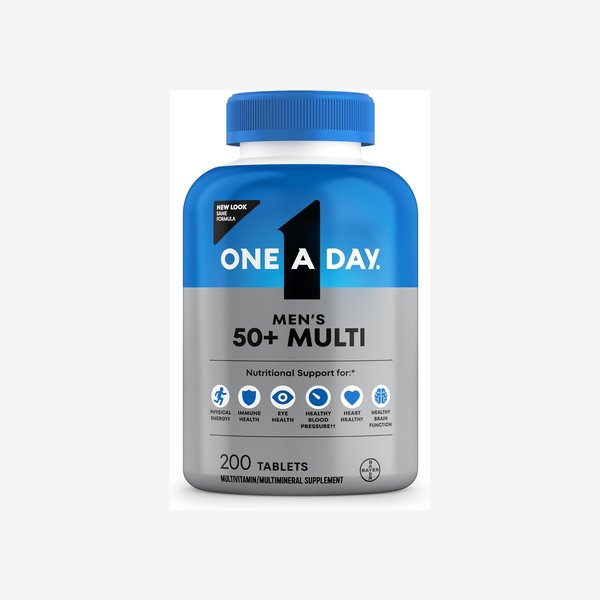
One A Day Men’s 50+ Complete Multivitamin
Age-specific multivitamin formulated for men over 50. Enhanced B12, vitamin D, and zinc to address nutrient gaps common after 50. Supports brain health, heart health, eye health, and immune function. No iron. ~$0.10/day.
- Formulated specifically for men 50+ nutritional needs
- Higher B12 to address age-related absorption decline
- Supports brain, heart, and eye health
- Very affordable at ~$0.10/day
- Vitamin D still conservative at 1000 IU
- Basic mineral forms with lower bioavailability
Quick Verdict
One A Day Men’s 50+ Complete Multivitamin takes the solid foundation of the standard Men’s formula and makes meaningful adjustments for men over 50 — higher B12, increased vitamin D, and nutrients targeted at the areas where aging hits hardest: brain function, heart health, and vision. At roughly ten cents per day, it’s one of the most affordable age-specific multivitamins available. It won’t replace a good diet or regular exercise, but as a daily nutritional safety net for men in their 50s and beyond, it’s hard to beat for the price. 4.3/5.
☑ Why You Can Trust This Review
- Our team personally tests every supplement we recommend — see our testing process
- All claims are backed by published research from peer-reviewed journals
- We are independently funded through affiliate commissions — brands cannot pay for rankings
- This content is written and reviewed by our editorial team
What Is One A Day Men’s 50+ Complete Multivitamin?
As men age past 50, their nutritional needs shift in measurable ways. Stomach acid production declines, reducing absorption of vitamin B12 from food sources. Skin produces less vitamin D from sunlight. Caloric needs decrease, meaning fewer total nutrients are consumed from food even when eating well. And the body’s antioxidant defenses weaken, increasing vulnerability to oxidative stress in the brain, heart, and eyes.
One A Day Men’s 50+ is Bayer’s response to these realities. It’s not a fundamentally different multivitamin from the standard Men’s formula — it’s the same core vitamin and mineral profile with targeted adjustments. B12 is increased to compensate for reduced gastric absorption. Vitamin D gets a bump. Nutrients that support cognitive function, cardiovascular health, and eye health receive emphasis.
Like the standard formula, it excludes iron — which is correct for most men at any age, but especially important for older men. Iron accumulation increases with age, and supplemental iron for men over 50 should only be taken under medical guidance for diagnosed deficiency.
The product is manufactured by Bayer HealthCare, which operates under pharmaceutical-grade quality controls. Bayer has been producing the One A Day line since 1940, making it one of the longest-running multivitamin brands in the United States.
Key Features & Specs
| Spec | Detail |
|---|---|
| Serving Size | 1 tablet daily |
| Target Demographic | Men age 50+ |
| Vitamin A | 900mcg (100% DV) |
| Vitamin C | 120mg (133% DV) |
| Vitamin D3 | 25mcg / 1,000 IU (125% DV) |
| Vitamin E | 15mg (100% DV) |
| Vitamin B6 | 3mg (176% DV) |
| Vitamin B12 | 15mcg (625% DV) |
| Zinc | 11mg (100% DV) |
| Selenium | 55mcg (100% DV) |
| Iron | None (by design) |
| Tablets Per Bottle | 200 (200-day supply) |
| Price Per Day | ~$0.10 |
| Manufacturer | Bayer HealthCare |
Key Differences From the Standard Men’s Formula
The most important adjustment is vitamin B12, which jumps to 15mcg (625% DV) compared to 6mcg in the standard formula. This isn’t megadosing for its own sake — it’s based on a well-documented biological reality. After age 50, the prevalence of atrophic gastritis increases significantly, reducing the stomach’s ability to cleave B12 from food proteins. The National Institutes of Health specifically recommends that adults over 50 get most of their B12 from supplements or fortified foods, since the synthetic (crystalline) form doesn’t require stomach acid for absorption. The 625% DV figure looks high on paper, but B12 is water-soluble with no established toxicity — your body simply excretes what it doesn’t need.
Vitamin D3 is increased to 1,000 IU (25mcg), up from 800 IU in the standard formula. This is a step in the right direction, though many experts still recommend 1,500–2,000 IU for older adults, especially those with limited sun exposure. Vitamin D is critical for bone density (a growing concern after 50), immune regulation, and emerging research links it to cardiovascular and cognitive health.
Vitamin B6 also gets a bump to 3mg (176% DV). B6 plays a role in over 100 enzymatic reactions including neurotransmitter synthesis (dopamine, serotonin, GABA), making it relevant for mood and cognitive function in aging men.
Vitamin C is increased to 120mg (133% DV), providing additional antioxidant protection. While vitamin C’s immune benefits are sometimes overstated, its role as an antioxidant and in collagen synthesis is well-established and increasingly relevant as the body’s repair mechanisms slow with age.
Pros & Cons
What We Like
- Age-appropriate B12 dose: The increase to 625% DV addresses one of the most common and underdiagnosed nutrient deficiencies in men over 50. B12 deficiency can manifest as fatigue, cognitive fog, mood changes, and peripheral neuropathy — symptoms often mistakenly attributed to “just getting older.”
- No-iron formula: Even more important for men over 50, who have had decades of iron accumulation. Hereditary hemochromatosis (iron overload) affects approximately 1 in 200 men of European descent, and even subclinical iron excess is associated with increased oxidative stress.
- Excellent value: At ~$0.10/day for a 200-count bottle, this is one of the cheapest age-specific multivitamins available from a major brand. The price premium over the standard Men’s formula is negligible — roughly $0.02 more per day for meaningfully adjusted dosing.
- One-tablet simplicity: Adherence is the biggest challenge with any supplement regimen, and it only gets harder with age as pill burden from medications increases. One tablet per day is as easy as it gets.
What Could Be Better
- Vitamin D is still conservative: While 1,000 IU is an improvement over the standard formula, many geriatric and endocrine specialists recommend 1,500–2,000 IU for men over 50, with higher doses for those who are confirmed deficient. Men with limited sun exposure (which describes most men over 50 who work or live indoors) may still need a standalone vitamin D supplement.
- Mineral forms remain basic: Like the standard Men’s formula, the 50+ version uses oxide forms for several minerals. Zinc oxide, for example, has significantly lower absorption compared to zinc picolinate or glycinate. At this price point, it’s an understandable trade-off, but it means you’re absorbing less than the label suggests.
- No lutein or zeaxanthin: For a product that emphasizes eye health support, the absence of dedicated eye-health nutrients like lutein and zeaxanthin is a gap. These carotenoids have strong evidence for reducing age-related macular degeneration risk, which becomes relevant after 50.
- No USP Verified certification: Unlike Centrum for Men, One A Day doesn’t carry USP Verified certification, which independently verifies that the product contains what the label claims, is free of harmful contaminants, and is manufactured under good practices.
How It Compares
Against the standard One A Day Men’s formula, the 50+ version is a straightforward upgrade for men in the target age group. The higher B12 alone justifies the switch — at a price difference of roughly $0.02/day, there’s no reason for a man over 50 to buy the standard version instead.
Compared to Centrum Multivitamin for Men, the 50+ formula competes well on price ($0.10 vs. $0.11 per day) and offers the age-specific adjustments that standard Centrum lacks. However, Centrum carries USP Verified certification, includes a broader range of 23 micronutrients, and uses some improved ingredient forms. Centrum also makes a Silver (50+) version that would be the more direct comparison — at a similar price point, the choice comes down to whether you value USP certification (Centrum) or Bayer’s brand track record (One A Day).
Against premium 50+ multivitamins like Garden of Life MyKind Organics Men’s 40+ or Thorne Men’s Multi 50+, One A Day can’t compete on ingredient quality, bioavailability, or nutrient range. But those products cost $1.00–$2.00 per day — ten to twenty times the price. For a man on a fixed income or one who simply doesn’t want to spend $500+ per year on a multivitamin, One A Day 50+ provides the essential coverage at a fraction of the cost.
See our full Best Multivitamins for Men 2026 guide for a complete comparison of all our top picks.
Who Should Buy One A Day Men’s 50+
- Men over 50 who want affordable, age-appropriate nutritional coverage
- Anyone concerned about B12 absorption — the enhanced dose addresses the most common nutrient gap in this age group
- Men who prefer a trusted, established brand they can find at any pharmacy
- Those currently taking the standard One A Day Men’s who have crossed the 50 threshold — the switch is seamless and practically free
Who Should Skip It
- Men under 50 — the standard Men’s formula is more appropriate and slightly cheaper
- Anyone who needs high-dose vitamin D (get a standalone D3 supplement or a multivitamin with 2,000+ IU)
- Men who want premium, clinically-dosed formulas with chelated minerals and specialty nutrients — this is a basic-tier product at a basic-tier price
- Those taking blood thinners or multiple medications should consult their doctor before adding any multivitamin, as vitamin K and other nutrients can interact with common medications
Where to Buy
One A Day Men’s 50+ is available at Amazon, Walmart, Target, CVS, Walgreens, and most grocery store pharmacies. The 200-count bottle represents the best value and is commonly available through Amazon Subscribe & Save for additional savings. Costco and Sam’s Club occasionally carry large-count bottles at even lower per-tablet pricing.
Check Current Price on AmazonFrequently Asked Questions
At what age should I switch from One A Day Men’s to the 50+ version?
The 50+ formula is designed for the nutritional changes that accelerate after 50, but there’s no hard cutoff. If you’re 48–50, the switch won’t cause any issues — the adjusted doses are safe for adults of any age. The key inflection point is when B12 absorption starts declining, which typically begins in the late 40s to early 50s.
Can I take this if I’m also on prescription medications?
Generally yes, but check with your pharmacist or doctor. The most common interactions to watch for are vitamin K with blood thinners (warfarin/Coumadin), calcium with certain antibiotics, and high-dose B6 with levodopa (Parkinson’s medication). The doses in One A Day 50+ are moderate enough that interactions are uncommon, but it’s always worth verifying.
Should I take it with food?
Yes. Taking it with a meal that includes some dietary fat improves absorption of the fat-soluble vitamins (A, D, E, K). It also reduces the chance of mild stomach upset, which some men experience when taking vitamins on an empty stomach. Breakfast or lunch is ideal.
Is the B12 dose too high at 625% DV?
No. Vitamin B12 is water-soluble with no established Tolerable Upper Intake Level — meaning no toxic dose has been identified in research. The 625% DV sounds dramatic but translates to 15mcg, which is well within the range recommended by the NIH for adults over 50. Your kidneys will excrete any excess. The high percentage of DV is necessary because absorption of crystalline B12 from supplements is only about 1–2% at doses above 1mcg.
Does this help with prostate health?
One A Day 50+ contains zinc (11mg) and selenium (55mcg), both of which play roles in prostate function. However, it does not include dedicated prostate-support ingredients like saw palmetto, beta-sitosterol, or lycopene. If prostate health is a primary concern, you’d need a separate supplement or a multivitamin specifically formulated for prostate support.
Will this help with joint pain or stiffness?
A basic multivitamin is not formulated for joint support. While vitamin D and certain antioxidants have indirect roles in reducing inflammation, One A Day 50+ does not contain glucosamine, chondroitin, collagen, or omega-3 fatty acids — the nutrients most studied for joint health. Consider a dedicated joint supplement if that’s your priority.
How is this different from Centrum Silver Men’s 50+?
Both are age-specific multivitamins from pharmaceutical brands at similar price points. Centrum Silver tends to include a broader range of micronutrients (23 vs. a slightly smaller roster for One A Day) and carries USP Verified certification. One A Day 50+ counters with competitive B12 and B6 dosing and slightly lower cost. Functionally, they’re very similar products — the biggest differentiator is Centrum’s independent quality verification.
Final Rating: 4.3/5
One A Day Men’s 50+ Complete Multivitamin does exactly what it should — it takes a proven, affordable formula and adjusts it for the specific nutritional realities of men over 50. The enhanced B12 addresses a legitimate and widespread deficiency risk, the price is nearly unbeatable, and the one-tablet format makes daily compliance effortless. It loses points for conservative vitamin D dosing, basic mineral forms, and the lack of USP Verified certification. But for the vast majority of men over 50 who want a simple, affordable daily multivitamin from a brand they recognize, this delivers solid value. Pair it with a standalone vitamin D3 supplement and you’ve covered the most important bases for about $0.15 a day total.
See Today's Price on AmazonLast updated: February 2026. We re-evaluate our reviews regularly based on formula changes, pricing, and reader feedback.